
1st Deposit only (min £10). Max Bonus: £25. WR of 10x Bonus (Slots only). Max bet: 10% (min £0.10) of Bonus or £5 (lowest applies). Use code: Slingo25. Bonus Policy applies.
Your official site for Slingo games







Play Online Roulette Games at Slingo UK
Online roulette is easy to dip into and fun to explore. At Slingo, you’ll find different ways to play, from classic table formats to live roulette with real-time action on screen. Some players like to keep it traditional. Others want a faster, more modern feel. Either way, Slingo gives you the essentials without overcomplicating things. You can get familiar with roulette types, bet styles, and how the casino game works.
What you’ll find in Slingo Online Roulette
Roulette isn’t one-size-fits-all.
You can keep it classic, go live, or browse around until something clicks here at Slingo. Some games feel stripped-back and simple. Others bring more of that real-table atmosphere to the screen.
You might come across:
- Classic roulette tables
- European, American, and French roulette formats
- Live roulette streamed in real time
- Different layouts, views, and table styles
- Games built for mobile, desktop, and tablet
Quick and simple? It’s here. More live-table energy? That’s here too!
How Online Roulette Works
Roulette is easy to get the hang of. You pick where you want your bet to go, the wheel spins, and the ball lands on a number.
You can bet on a single number, a small group of numbers, or a broader outcome like red or black. Once betting closes, it’s over to the wheel.
Some games keep things fully digital. Others bring in a live dealer and a real wheel on screen. Different setup. Same simple idea.
10 Things You Should Know About Online Roulette
- 1.
Wagers are separated into inside or outside bets. Within these categories, there are a number of different types of bets with different odds and payouts. Choose from a straight bet, a street bet, a column bet, and more.
- 2.
European roulette offers statistically better odds to players in comparison to its American counterpart. American roulette has a house edge of 5.27%, whereas European roulette’s house edge is 2.7%.
- 3.
French-style tables have La Partage and En Prison rules. If the ball lands on zero on outside bets, La Partage lets you recoup half of your stake. With En Prison, you have the option of leaving your stake on the table for another spin. These rules cut the house edge to just 1.35%.
- 4.
There are many different roulette variations. Some determine bet outcomes using a live dealer, whereas others generate outcomes using an RNG (random number generator).
- 5.
Most online casinos give you the option of switching to a ‘free’ or ‘practice’ mode so that you can familiarise yourself with roulette before playing for money.
- 6.
Fun fact: Roulette is a popular game for both men and women, and 46% of its players are female.
- 7.
Although there are many different variations of roulette online, the objective of the game always remains the same: to try to guess which pocket the ball will land in.
- 8.
In live roulette the ball is made of plastic or ivory and lands in ‘pockets’ on the wheel that are separated from one another by tiny walls known as ‘frets.’
- 9.
Some roulette games feature a ‘racetrack,’ which is an oval betting zone that is marked with numbers and resembles a racetrack. It helps players quickly and easily place bets during play.
- 10.
Roulette is played purely by luck; winning and losing is all part of the fun.
Types of online roulette
Online roulette comes in a few different forms, and each one has its own feel. Some keep things classic. Some feel a little more polished or traditional. Some bring a live table straight to your screen. Here’s a quick look at the main types you’re likely to come across.

American Roulette
American roulette wheels feature 38 slots numbered 1 – 36, a zero and a double zero, which gives odds of 37:1 and a house edge of 5.27%. The 00 increases players’ stakes, since additional spaces on the wheel mean more money to be lost. However, American roulette wheels are easier to understand because adjacent numbers are opposite each other on the wheel. Many rules applied in a European roulette game, such as “la partage” and “en prison” do not apply in the American version. The overall objective of the game remains the same, with players betting on which pocket the ball will land in. If that style sounds like your kind of spin, you can try and explore American Roulette game.

European Roulette
European roulette wheels have 37 slots numbered 1 - 36 with one zero. This gives odds of 36:1 and a house edge of 2.7%, which is significantly lower than that of American roulette. This makes it a better option for those who want to offset the effect of variance and it offers better odds. The overall objective of the game remains the same, as players try to predict which pocket the ball will land on. However, the wheel is laid out differently and adjacent numbers are not opposite each other on the wheel. If you want to explore this format in more detail, European Roulette Pro Special is one example to take a look at.

French Roulette
French roulette is very similar to European roulette. The wheels are the same, but the table layout and the placement of some of the betting areas is different. French roulette has 37 slots numbered 1 - 36 and one zero, giving the same 36:1 odds and 2.7% house edge as European roulette. This house edge drops to 1.35% if the “la partage” is applied at the table because it means that half of the players’ even-money bets will be returned if the ball lands on zero (“la partage” means “sharing” in French). If you want to see this format for yourself, French Roulette Pro Special is a good one to explore.

Live Dealer Roulette
Live dealer roulette features a real dealer, who uses a physical roulette table and manages the betting process in real-time. This is broadcast to players via a live video stream, and they can watch the wheel being spun. Like real roulette in a casino, the outcome of the spin is determined by a physical spin of the wheel. This differs from traditional online roulette, where the outcome is determined by a Random Number Generator (RNG). If you want to explore this side of roulette a little more, VIP Roulette and Grand Casino Roulette are two examples of live dealer games you’ll find in the mix.
Players make their decisions by using a computer screen console. Some live dealer roulette games allow players to interact with the dealer and with other players, making it an enjoyable option for many people. Live dealer roulette is a popular choice with many players because it offers a fun gaming experience that is as close as possible to the actual environment at a physical casino.
How to Play Roulette - Rules
Getting started with roulette is easier than it might look. Pick your bet. Choose your stake. Watch the spin and see where the ball lands.
Here’s how a round usually goes:
- 1.
Choose a number, a group of numbers, or a broader bet like red or black.
- 2.
Set the amount you want to stake.
- 3.
Place your bet before the spin begins.
- 4.
Wait for the wheel to spin and the result to be revealed.
- 5.
Check whether your selection matched the outcome.
- 6.
Ready for another round? Place a new bet and go again.
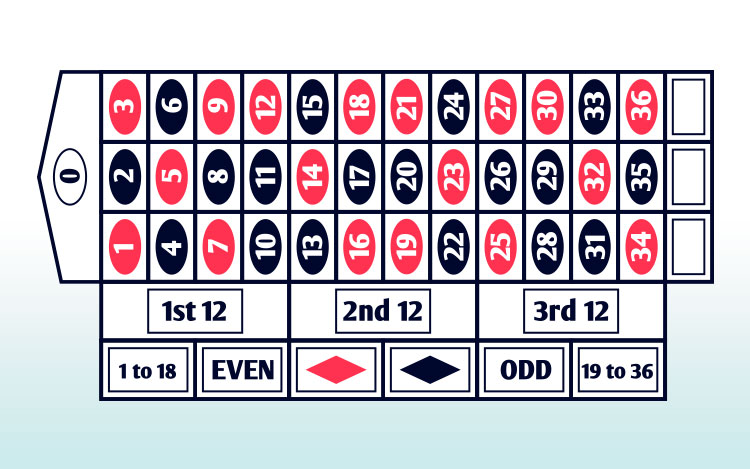
Roulette bet types explained
Roulette bets usually fall into two camps: inside bets and outside bets. One keeps things more specific. The other gives you a bit more coverage on the table.
Inside bets
Inside bets focus on individual numbers or smaller groups of numbers on the betting grid. They are the more precise picks on the table.
These can include:
- Straight up bets on one number
- Split bets on two numbers
- Street bets across a row
- Corner bets on four numbers
- Line bets on six numbers
They are more specific by nature, so potential payouts are usually higher.
Outside bets
Outside bets cover broader sections of the table. They are based on wider outcomes rather than exact numbers.
These can include:
- Red or black
- Odd or even
- High or low
- Dozens
- Columns
Because these bets cover more possible results, payouts are usually lower than with inside bets.
Understanding Odds in a Roulette Game
Understanding odds in roulette is quite simple. When playing American roulette, the odds of winning on a single number straight-up bet are 37:1 and the payout is 35:1.
Since the European roulette wheel only features one zero, the odds of winning are higher at 36:1 and the payout for a single number bet remains at 35:1.
There are three different types of bets in roulette: inside bets, outside bets and neighbour bets. They offer different odds, and players must decide whether they prefer to place higher- or lower-risk bets.
The inside section, or inside bet, offers higher odds and is the riskier betting area on the table. It allows you to bet on individual numbers, or groups of up to six numbers, that are in close proximity to each other according to the way the table is laid out. In this part of the table the chances of winning are lower, but the payout is higher if you do win.
The outside section offers lower odds and less risk. It contains matching pairs of bets for high or low, odd or even, and red or black. Players can also make six different 12-number bets, which are called “column” and “dozen” bets. Playing at this part of the table gives you a better chance of winning, but the payout is not as big.
How the Roulette Wheel Came About
The roulette wheel was invented by chance in 1655 by Blaise Pascal, a French physicist, inventor and mathematician. Pascal was actually trying to invent a perpetual motion machine that continues to operate without drawing energy from an external source. Although this proved impossible, the process did create an early prototype of today’s roulette wheel.
Interestingly, the zero didn’t exist on the wheel until the mid-19th century, when Francois and Lois Blanc designed a wheel with a zero specifically for King Charles III of Monaco. At the time the country was struggling financially, so with a bigger house edge, the wheel was able to generate a lot of income for Charles’ kingdom!
Choosing a roulette style that suits you
Roulette has a few different moods. That’s part of the appeal.
Some players like the familiar feel of European roulette. Some want the cleaner pace of a digital table. Others prefer live roulette, with a dealer on screen and more of that real-table atmosphere.
Not sure where to start? A quick scan of the basics usually helps:
- Wheel type
- Bet layout
- Live or digital format
- Interface style
- Device compatibility
Browse a little. Compare what’s there. Then go with the version that feels like your kind of game.
FAQs about Online Roulette
- 1.
What is online roulette?
Online roulette is roulette played on a website or app. Some versions are fully digital. Others are streamed live with a dealer on screen.
- 2.
What is the difference between European and American roulette?
The main difference is the wheel. European roulette uses a single zero. American roulette uses a zero and a double zero.
- 3.
Can I play live roulette online?
Yes. Live roulette is streamed in real time and uses a real dealer and physical wheel.
- 4.
What are inside and outside bets in roulette?
Inside bets focus on exact numbers or smaller number groups. Outside bets cover broader outcomes, like red or black, odd or even, or larger table sections.
- 5.
Is roulette a game of skill?
No. Roulette is a game of chance. The result of each spin is not influenced by player skill.
- 6.
Can I play roulette on mobile?
Yes. Many online roulette games are built for mobile, desktop, and tablet play.
Follow us on


Play On The Go
Slingo: Slots & Bingo Games


